
Jim Boyce Memorial Scholarship
This memorial scholarship is in honor of Jim Boyce
and all of our former APA members and supporters, who made a lasting impact in the field of accessibility compliance. By encouraging students to make accessibility part of their career development, we hope to further promote accessibility in the built environment.

APA is a 501(c)(3) tax exempt organization under the Internal Revenue Code. Contributions are deductible under section 170 of the Code. APA is also qualified to receive tax deductible bequests, devises, transfers, or gifts under section 2055, 2106, and 2522 of the Code.
Who should apply
Students who wish to apply must be currently pursuing a degree in architecture, landscape architecture, civil engineering, construction management, interior design, or other degree program closely related to accessibility/universal design at an accredited United States institution of higher learning. Students must have a 2.5 or higher GPA and demonstrate a strong interest in accessibility in both design portfolio and future career interests.
Each year, applications are accepted through March, and the scholarship is awarded in May via the attended institution’s financial aid office.
When and how to apply
The 2027 Scholarship application will open in the fall. If you have any questions, email JBMS@APAaccess.org.
Announcing the 2026 Scholarship Recipients
We are pleased to announce the winners of the 2026 APA Scholarship Awards. This annual scholarship recognizes students dedicated to advancing accessibility in the built environment.
Congratulations to this year's recipients!

Mya DeAngelis
An undergraduate student studying construction management
“Receiving the Jim Boyce memorial scholarship affirms my commitment to planning, designing and building spaces that go beyond ADA requirements. I'm now able to devote more time and energy to my education and for that I'm incredibly grateful. I look forward to continuing my studies and contributing to a more accessible world.”

Connor Trang
An undergraduate student studying interior design
“Receiving the Jim Boyce Memorial Scholarship from the Accessibility Professionals Association is incredibly meaningful to me as a student focused on accessibility, inclusive design, and improving how people experience the built environment. More than financial support, this scholarship represents a shared commitment to creating spaces that are thoughtful, equitable, and welcoming to all. I am honored to continue pursuing work that advances accessibility while carrying forward the values this scholarship represents.”
Thank you to everyone who applied this year, and congratulations again to our 2026 winners.
This scholarship is made possible by the generosity of all those who donate!
Interview with a past JBMS winner
Trent Tunks likes to think big. The winner of the 2018 APA Jim Boyce Scholarship is drawn to large urban design projects and this focus is fused into his academic and long-range future plans.
His goal is to graduate in the fall of 2020 with his Master of Architecture degree from the University of Texas building on his undergraduate architecture degree from UTSA.
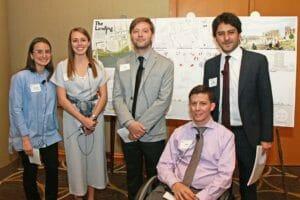
He has already distinguished himself as a capable and creative architect-in-training. Notably, he has joined other students in a highly competitive design competition where he took home honors as a finalist. The Urban Land Institute (ULI) Hines Student Competition is a prestigious challenge to architectural students to collaborate across disciplines to dream and design a better built environment. Groups of five students form teams to devise a development plan for a real American city site, including designs and market data.
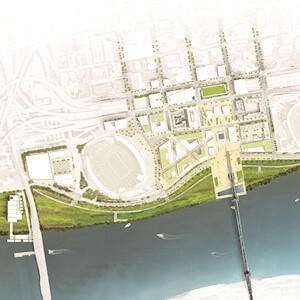
His University of Texas project, The Landing, created a design for Cincinnati that envisioned sweeping green spaces in an urban environment that promotes renewable energy efforts with social connectivity.
He explained his appreciation for what he calls "democratic space" that offers ample room for walkways, stairs and ramps. A wheelchair user, Trent knows first-hand the advantages and aesthetics that come with public spaces that make life easier for everyone.
In addition to his life experience adapting to wheelchair use from the age of 16, he has seen the need for architects to incorporate more accessibility, even if in small ways. While working with the AIAS Freedom by Design program at UTSA, he described one eye-opening experience of a woman who could not leave her house on her own simply because she could not hold a door open. "It took just a new door closer and new handles for her to come and go on her own. I call that freedom by design."
Inspirations such as these motivate him to expose architecture peers to wheelchair use and how it impacts design. One senses that he is on a professional and personal quest... "How can we make access more integrated? Is there a better way?"
Trent notes the scholarship has been a long-time goal and even applied as an undergraduate. He commended the mission of the Accessibility Professionals Association with a heartfelt comment "It is incredibly important to bring accessibility to the forefront - I am so thankful and honored!"
by Maggie McCarthy